
America 250 is Closer Than You Think
By Mary Beth Martin
This year, communities across the country are celebrating America 250, the semiquincentennial anniversary of the signing of the Declaration of Independence. It’s been encouraging and inspiring to see people and organizations finding unique ways to reflect on our nation’s beginnings and the stories that shaped it.
What I’ve realized lately is this: the story of America 250 is all around us — often in places we least expect.
Over the past few weeks, I’ve visited several sites within an hour or so of Shelby, either with my family or on my own, and I’ve discovered just how connected they are to the story of the American Revolution. Sometimes we think of Revolutionary War history as something distant or confined to famous battlefields, but here in our region, it’s woven into trails, rivers, crossings, and communities we still visit today.
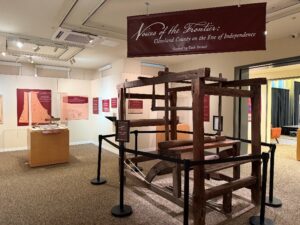
Here at the Earl Scruggs Center, we’re joining the nationwide America 250 celebration in our own way through our special exhibit, Voices of the Frontier: Cleveland County on the Eve of Independence. The exhibit explores the lives of the Indigenous people, settlers, and enslaved individuals who lived in this region before and during the Revolutionary era.
Cleveland County played an important role in the Revolution through the Battle of Kings Mountain, but before that famous victory, this area was part of the Carolina frontier — remote from the eastern coast, but deeply connected to the growing movement for independence.
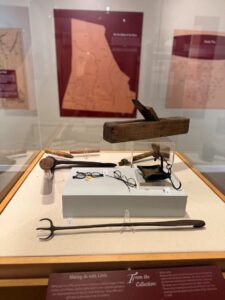
Objects from the Cleveland County Historical Collection featured in Voices of the Frontier: Cleveland County on the Eve of Independence. Photo taken by Mary Beth Martin.
We also partnered with North Carolina Humanities to host By the People: Music from the Old North State, a program that explored the music and culture of Western North Carolina with WNCW 88.7’s Joe Kendrick, musician Laura Boosinger, and educator and cultural organizer Dr. Jordan Laney. I found it especially meaningful that the conversation highlighted musicians from many different backgrounds and walks of life whose stories and traditions helped shape our state’s music, culture, and identity. The program reminded me that understanding our history means listening to many voices — and recognizing how the experiences and contributions of Indigenous communities, African Americans, immigrants, settlers, and working people all became part of the cultural traditions we still celebrate today.
I hope you’ll visit Voices of the Frontier and join us for the exhibit-related programming, which you can find on our website, but I also encourage you to explore beyond museum walls. America 250 is happening everywhere — in parks, trails, small museums, historic pathways, music venues, family stories, and places you may have driven past dozens of times.
To me, one of the most meaningful ways to celebrate America 250 is by learning more about the people who shaped our communities and cultural traditions — not only famous historical figures, but ordinary people whose lives, labor, music, beliefs, and experiences became part of the story of our region. The history of the Carolina Backcountry belongs to many different people and cultures, and taking time to learn those stories helps us better understand both our past and one another today.
Most of us here in Cleveland County are already familiar with important Revolutionary War sites like Kings Mountain National Military Park and Cowpens National Battlefield, which are both absolutely worth visiting or revisiting during this time of celebrating America 250. I recently took my daughter to Cowpens and we enjoyed walking and learning about the battle on the Battlefield Trail, and we took the extra trail to the Robert Scruggs Cabin, a wonderful example of a mid-1800s homestead that has a distant connection to Earl Scruggs and his family.
I also highly encourage visits to the Kings Mountain Historical Museum and the Catawba Cultural Center in Rock Hill to gain a deeper understanding of the people and cultures that shaped our region long before and during the Revolutionary era. And don’t miss the fall performances of the excellent Liberty Mountain: The Revolutionary Drama at the Joy Theatre in Kings Mountain.
Beyond these well-known places, here are a few sites I’ve personally explored over the past several weeks — places where we discovered connections to the American Revolution and the Carolina Backcountry story that surrounds us every day.
Carolina Rising Museum – Gaffney, SC
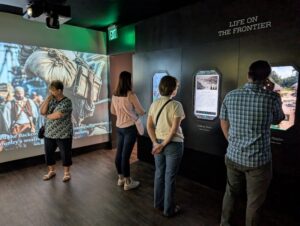
The Carolina Rising Museum is a newly opened, immersive museum experience that tells the story of the Carolina Backcountry leading up to the Revolution. I first took my family there a few weekends ago, but on International Museum Day, our ESC staff took a field trip there and thoroughly enjoyed our trip.
We were amazed at how effectively they use technology, interactive storytelling, facial recognition, and AI-driven characters to bring history to life. What impressed me most was the personalization of the experience for every visitor. When my 9-year-old daughter approached the screens, the information and prompts displayed for her were different from what my husband and I saw. The museum has created an experience that adapts to the visitor, making history engaging for both children and adults.
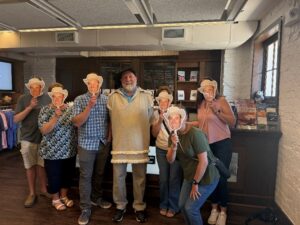
Another aspect I found especially powerful was the way the stories are presented by the people who personally experienced the American Revolution in the region. You might wonder how that is possible but visit and you’ll see what I mean!
At the Earl Scruggs Center, we’ve recently installed several new interactive experiences ourselves, so I know firsthand how much planning, creativity, and investment goes into exhibits like these.
If you visit, plan to spend more than hour there — it’s absolutely worth it.
Landsford Canal State Park – Catawba, SC
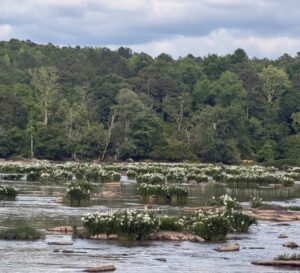
Landsford Canal State Park has been part of my life for as long as I can remember. I grew up visiting the park and was always fascinated by the canal remains built to help boats transporting goods navigate around this rocky stretch of the Catawba River.
Over Mother’s Day weekend, my family visited again for a picnic with my parents and to see the rocky shoal spider lilies blooming— something that only happens for a short window in May and June. It’s the largest known stand of rocky shoal spider lilies, and it’s breathtaking.
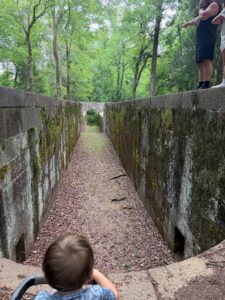
The walk to the spider lilies observation deck is about a mile down a well-maintained trail. There are some nice benches along the way if a rest is needed, and I had an easy enough time with the stroller. The Canal Trail is a little more difficult, with some steps and rough areas, but fascinating history and canal ruins.
What surprised me this time, though, was learning more about the site’s Revolutionary-era connections. Historical markers explain how Lands Ford served as a major crossing point along the Great Wagon Road and how both Patriot and British troops traveled through the area during the Revolutionary War.
It was a reminder that even places we know well can still surprise us with new layers of history.
Alexander’s Ford – Polk County, NC (near Rutherfordton)
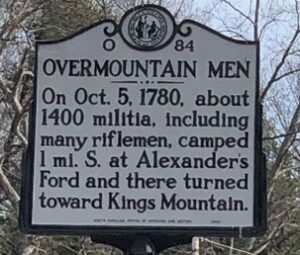
https://www.hmdb.org/m.asp?m=240873
I recently searched for a (new to me) nearby hike and ended up at Bradley Nature Preserve for the Alexander’s Ford trail where I accidentally walked straight into Revolutionary War history.
Accessible by a gravel road at the end of Gray’s Chapel Church Road, you’ll find the trailhead just past the Bradley Nature Preserve sign, with a few parking spaces and a covered picnic shelter.
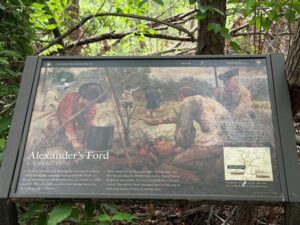
The trail itself is an easy 2.6-mile roundtrip walk through beautiful forest leading to the Green River. Along the way, I learned that this location served as an important campsite for the Overmountain Men during their pursuit of British Major Patrick Ferguson in October 1780.
While camped along the Green River at Alexander’s Ford, the militia received word that Ferguson was moving toward Charlotte to meet Cornwallis. The Overmountain Men quickly changed course, gathered additional militia forces, and within days fought at the Battle of Kings Mountain on October 7, 1780.
Standing there beside the river, it was remarkable to think about what people camped there on October 5, 1780 experienced – the anxiety and fear, or the determination they felt at that moment-- and how close this history really is to us.
The hike itself is peaceful and beautiful, though I definitely recommend insect repellent. You’ll see the impact of Hurricane Helene in the area as many trees are down throughout the forest, with some crossing the trail. Conserving Carolina has done a lot of hard work to clear the path and preserve this area, I’m grateful for it.
If you’d like to learn more about the trail:
Alexander’s Ford Hike Information
As America 250 continues, I hope you’ll take time to look around your own community and explore the stories nearby. You may be surprised by what you discover — not only about the American Revolution, but about the people, traditions, and experiences that shaped the places we call home.
Some of those stories are inspiring, some are complicated, and some may challenge what we thought we knew. But all of them help us better understand the shared history of our region and country. Whether through music, historic sites, museums, family stories, or cultural traditions passed down through generations, we have so much to learn from the people around us.
For me, that feels like one of the best ways to celebrate America 250: by listening carefully, learning deeply, and recognizing that the American story has always been made up of many voices.