
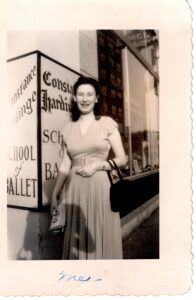
One of the most meaningful parts of our work at the Earl Scruggs Center is sharing the stories behind the music with our visitors, members, and friends. Not just how the music was made — but the people whose vision and determination made it possible. This month, I want to shine a light on someone who continues to inspire our work every day: Louise Scruggs.
Many people know Louise as Earl’s wife. But she was also his manager, strategist, business partner, and the driving force behind one of the most influential careers in American music. Legendary artist Marty Stuart once said Louise “was to the business what Lester and Earl were to the music.” That tells you everything you need to know.
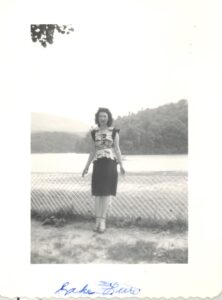
Louise was raised to love music, much like Earl himself. Her grandmother played organ and guitar, and her grandfather took her to the Grand Ole Opry in Nashville. These experiences clearly shaped her lifelong connection to the music and the people who made it. Born into a farming family in Grant, Tennessee, she graduated high school in 1945 and moved to Nashville to work in accounting — a practical decision that placed her at the center of music history.
In 1946, she saw Earl perform with Bill Monroe and his Blue Grass Boys at the Opry, and they met soon after. They married on April 18, 1948, around the time Earl joined forces with Lester Flatt to form Flatt and Scruggs.
Earl’s nephew, J.T. Scruggs, shared that on the day of their wedding, Earl drove his mother to Boiling Springs Baptist Church near Flint Hill, then crossed the state line into Gaffney, S.C., to marry Louise at the Justice of the Peace—and returned in time to pick up his mother after the service. Recently, a Probate Judge in Cherokee County, S.C., came across their marriage license from 1948 and mailed a copy to us for the collection. That was such a thoughtful gesture, and we are delighted to have it.
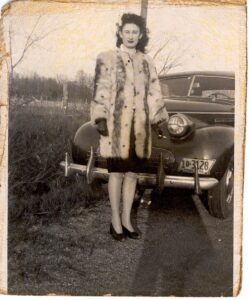
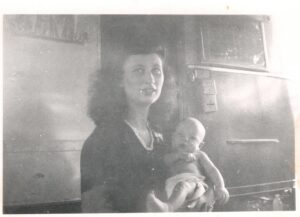
In those early Flatt and Scruggs days, life on the road was difficult. The Scruggs family moved constantly, and Louise managed their young and growing family while Earl traveled all over the southeast with the band. We have wonderful photographs from that era — especially of their oldest son, Gary, as a toddler, while they lived in trailer communities — that show the challenges and happiness of those early years.
At a time when women rarely held leadership roles in the music business, Louise stepped in and began booking the band in 1955 and eventually managed every aspect of the duo’s career: bookings, contracts, publicity, image, and long-term strategy. She understood branding and audience development decades before those ideas were industry buzzwords.
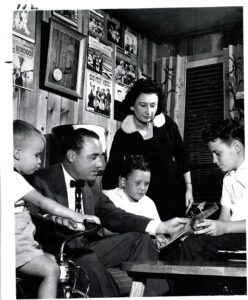
In 1959, she booked Earl to perform at the first Newport Folk Festival, where his three-finger banjo style stunned audiences and helped introduce bluegrass to the national folk revival. Louise later booked Flatt & Scruggs for Newport in 1960 and 1966. She also strategically positioned the duo as country artists for radio play, knowing many stations would not program bluegrass.
Louise constantly looked ahead, finding opportunities to expand beyond traditional country and bluegrass audiences — from folk enthusiasts to college campuses to major pop festivals. She approved recording “The Ballad of Jed Clampett,” the theme to The Beverly Hillbillies, and the duo’s appearances in the hit series, after initially worrying it might stereotype rural Southerners. She envisioned the landmark live album Flatt and Scruggs at Carnegie Hall! and conceived the album Songs of the Famous Carter Family, featuring Maybelle Carter. She didn’t just manage their success — she created it.
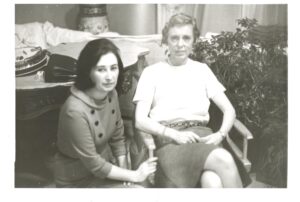
One of the things I love most is seeing Louise’s fingerprints throughout our collection. Just a few of the items she saved include scrapbooks, behind-the-scenes photographs of Flatt & Scruggs, the Earl Scruggs Revue, and the Scruggs family — many labeled in what I recognize as her handwriting. She clearly understood that the world would treasure these items and that the Scruggs family was making a lasting impact on music.
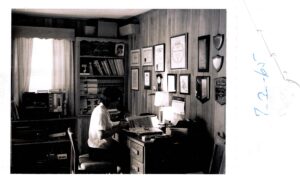
Louise’s influence on the music industry is still recognized today. The Country Music Hall of Fame and Museum established the Louise Scruggs Memorial Forum in 2007 to honor trailblazing women in music, and she was inducted into the Bluegrass Music Hall of Fame in 2010.
At the Center, visitors can explore her life and career in our Out of Carolina gallery. In The Turning Road gallery, we highlight her marketing and creative vision through the Scruggs partnership and friendship with illustrator Thomas Allen— a story you truly must see in person. Our new Strings on Screen interactive exhibit also includes a short film about Louise, narrated by Alison Brown, 2025 Louise Scruggs Memorial Forum honoree whose groundbreaking career continues the legacy Louise helped create. Alison will join us as Artist in Residence and will be one of the first to perform on the Louise Scruggs Stage at this year’s Earl Scruggs Music Festival.
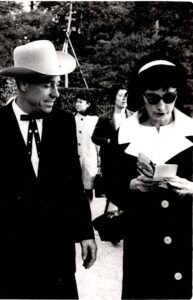
We also celebrated Louise’s birthday on February 17 by announcing this newest stage in her honor — the Louise Scruggs Stage is small but meaningful way to make sure her name stands proudly alongside the music she helped shape.
As Executive Director, I often find myself asking, What Would Louise Do?
She led with excellence, courage, and vision. Long before we were a reality, Louise believed in and supported the creation of the Earl Scruggs Center, the people behind it, and our mission. She understood that success comes from seeing possibilities where others only see obstacles. Honoring Louise Certain Scruggs means telling her story fully — not just as part of Earl’s history, but as a powerful legacy of leadership, foresight, and determination that continues to shape the music we love.
And that’s a story worth sharing.
— Mary Beth Martin
Executive Director
*Photos from the Earl Scruggs Center collection.*